


In this article:
- When Should You Dispute Information on Your Credit Report?
- Situations That Usually Don't Warrant a Dispute
- 3 Ways to Dispute Information on Your Credit Report
- How to Dispute Credit Report Items Online With Experian
- What Happens After You Submit a Dispute?
- How Disputes Can Affect Your Credit Score
- What to Do if Your Dispute Is Rejected
- How to Monitor Your Credit Report for Possible Errors
A credit report dispute is a formal request asking a credit bureau to correct or remove information you believe is wrong. You have the right to dispute credit report information with the credit bureaus to have your credit report corrected or updated. You can dispute credit report information online, by mail or by phone with each credit bureau.
Errors on your credit report can affect lending decisions, the interest rates you're offered and other financial opportunities. That's why it's important to check for inaccuracies, even though they're relatively rare. Not every negative item qualifies for a dispute, though, and accurate information generally stays on your report whether you like it or not. Here's how to tell which items are worth disputing, how to file a dispute with each credit bureau and what to expect once the investigation begins.
When Should You Dispute Information on Your Credit Report?
Disputes work best when you have a clear, factual reason to believe something in your report is wrong. The four situations below are the strongest candidates for a successful dispute.
The Information Is Incorrect
This is the most common reason people file a dispute. Maybe a payment is marked late even though you paid on time, a balance or credit limit doesn't match your records, or an account you closed years ago still shows as open.
The Information Is Incomplete
Sometimes the information isn't wrong, exactly, but it's missing details that change how an account looks to a lender. An account you've paid off might still show a balance, or a collection account you settled might be listed as money you still owe. The goal here is to complete the picture rather than remove the information.
Learn more: What Do "Closed" and "Paid in Full" Mean on Credit Reports?
The Information Cannot Be Verified
Under federal law, a credit bureau has to remove anything it can't verify, so if the company that reported an item can't confirm it's accurate during the investigation, the bureau has to correct or delete it. This may come up with older accounts, where the original details can be hard to track down.
The Information Appears to Be Fraudulent
An account or inquiry you don't recognize can be an early sign of identity theft. If you spot a loan or credit card you don't recognize, dispute it right away. It's also a good idea to report the activity at IdentityTheft.gov, which can help you map out the rest of your recovery.
Situations That Usually Don't Warrant a Dispute
There's a common belief that any negative item will come off your report if you dispute it enough times, but that isn't how it works. Disputing accurate negative information won't make it disappear. If the data furnisher (a credit card issuer or other lender, for instance) confirms an item is reported correctly, it stays on your report until it ages off on its own.
Disputes are meant to fix genuine errors, not to erase accurate information you'd rather not see, so it helps to know the difference between inaccurate and simply unfavorable.
Accurate Negative Information
Late payments, charge-offs and collections that are reported correctly are part of your credit history, and they generally stay on your report for up to seven years. Disputing them won't speed that up, because there's nothing for the bureau to fix.
Information That Feels Unfair but Is Correct
A late payment from a difficult financial stretch or a high balance left over from an emergency can feel unfair. But a dispute only looks at whether an item is accurate, not whether it's fair, so anything that really happened will stay put.
Attempting to Remove Accurate Information Early
Accurate negative items eventually age off your report on their own. Trying to speed up the process by disputing them won't remove them early, so it's best to wait until they fall off naturally.
3 Ways to Dispute Information on Your Credit Report
You can dispute credit report information with the three national consumer credit bureaus online, by mail or by phone. Filing online is likely the fastest and most convenient option, though some information, such as an incorrect name or address, can't be disputed that way.
- Online: Each bureau has its own online portal for submitting disputes. With Experian, you'll register for a new account or sign in to your existing account to begin.
- By mail: Download the bureau's dispute form and follow its mailing instructions. Experian's form and instructions are available online, and the Consumer Financial Protection Bureau (CFPB) offers a sample dispute letter. You may need to mail or upload copies of documents such as a government-issued ID and a recent utility bill.
- By phone: You can also call the bureau. If you call the number listed on your Experian credit report, an Experian dispute specialist will walk you through the process and explain which documents to submit.
| Experian | TransUnion | Equifax | |
|---|---|---|---|
| Online | Dispute website | Dispute website | Dispute website |
| Experian P.O. Box 4500 Allen, TX 75013 | TransUnion Consumer Solutions P.O. Box 2000 Chester, PA 19016-2000 | Equifax Information Services, LLC P.O. Box 740256 Atlanta, GA 30374-0256 | |
| Phone | Call the phone number listed on your Experian credit report | 800-916-8800 | 888-378-4329 |
How to Dispute Credit Report Items Online With Experian
The quickest and easiest way to dispute your Experian credit report is to check your credit report online and submit disputes through the online Dispute Center.
Here are the steps to take to submit a dispute with Experian:
- Gather the necessary documents. Have any screenshots and supporting documents ready to upload before you start.
- Start a new dispute in the Dispute Center. Click "Start a new dispute," then sign in to your existing membership or sign up for an Experian Service Account or a free Experian membership.
- Review your credit report. Your report is divided into sections in the Dispute Center—accounts, public records, personal information and inquiries—so find the one that contains the information you want to dispute.
- Choose the item to dispute. Select an account to review its history and information, or choose another item you believe is incorrect.
- Indicate the reason for the dispute. Pick a reason from the dropdown box, and add explanatory comments or attach supporting documents wherever the option appears. Some disputes can't be handled online, and you'll be asked to call Experian instead.
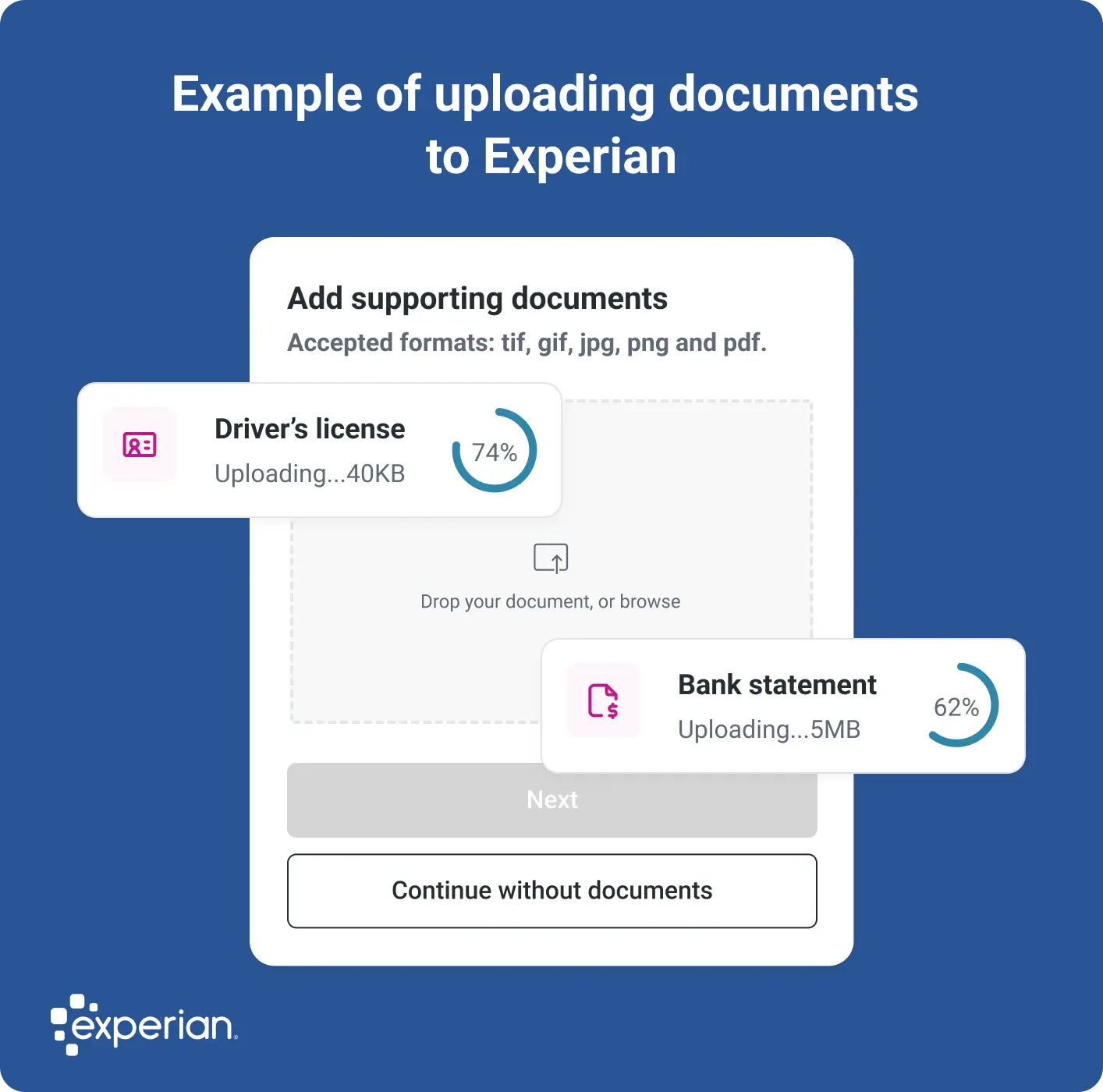
Upload documents to Experian. Submit your documents through the Dispute Center or by mail, keeping the originals for your records and including a copy of your government-issued ID if you mail them.
- Review and submit the dispute. Check the details, revise anything as needed and click "Submit." A confirmation page appears once the dispute is filed.
What Happens After You Submit a Dispute?
Once you file, the bureau takes it from there, and the process looks about the same no matter what you're disputing.
Investigation Process
Experian reviews your dispute and usually contacts the company that reported the information to pass along what you submitted and ask it to check its records. If the furnisher confirms the item, it stays. If it can't confirm it or finds it's wrong, the item is updated or removed.
Typical Timeline
Most disputes wrap up within 30 days, or up to 45 if you send extra documentation after the investigation is underway. Once the review is done, the bureau has five business days to share the results, and you'll get an updated copy of your report if anything has changed.
Learn more: How Long Do Credit Report Disputes Take?
Possible Outcomes
When the dispute is complete, Experian shows the outcome in your account's Alerts section. Here's what each one means:
| Possible Dispute Outcomes | |
|---|---|
| Added | The item was added to your credit report |
| Updated | The item you disputed was updated on your report |
| Verified and updated | The disputed item was verified as accurate, but separate, unrelated information was updated |
| Deleted | The item was removed from your credit report |
| Processed | The item was either updated or deleted |
| Remains | The company verified the information as accurate, so it wasn't changed |
Receiving Your Results
You can follow along in your account's Alerts section, and Experian can email you whenever the status changes. A few updates you might see include:
- Open: A new dispute has started.
- Update: The investigation is complete, and your report is being updated with the results.
- Dispute results ready: Your report has been updated with the results.
How Disputes Can Affect Your Credit Score
Filing a dispute doesn't affect your credit scores on its own, though some scoring models treat an account that's under dispute a little differently, so you might see a temporary shift while the investigation plays out.
What really matters is the outcome of the investigation. If the dispute causes a change to your credit report, it could have a positive, negative or no impact on your credit score.
When Your Credit Score May Improve
Your scores may go up if negative information comes off your report, such as late payments, a past-due account or a collection account that was reported in error.
When Your Credit Score May Drop
A dispute can occasionally work the other way. If you dispute a credit card and the whole account is removed, for example, you could end up with a shorter length of credit history or a higher credit utilization rate, both of which can pull your scores down.
When Your Credit Score May Not Change
Plenty of disputes don't change your scores at all. That's the case when the investigation doesn't lead to a change, and also when it updates information that scores don't consider, like your name or address.
Why Results Vary
Each scoring model weighs information a little differently, so one correction can move one of your scores more than another. The rest of your credit profile matters, too, so the same change can look big on one report and barely show up on another.
Learn more: What Affects Your Credit Scores?
What to Do if Your Dispute Is Rejected
If the item comes back verified instead of corrected, that doesn't have to be the final word. You still have a few options, especially if you have documentation that supports your dispute. Start by figuring out exactly why the item was verified, then decide where to go from there.
Review the Investigation Results
Read the notice closely so you know what was verified and why. This will make it easier to see what evidence or correction you'll need before you try again.
Submit Additional Evidence
If you've found new documentation that backs up your case, you can dispute the item again with that information attached. It's best to do this only when you have something genuinely new, since disputing the same item repeatedly can get it dismissed as frivolous.
Add a Consumer Statement
You can also ask the credit bureau to add a statement of dispute explaining why you think the information is wrong, which anyone who pulls your report will see. With Experian, you can add one in the Dispute Center by selecting the item and choosing "Add a statement."
Contact the Furnisher Directly
Another route is to go straight to the company that reported the information—using the contact details on your report—to show proof that its records are off. If it corrects the information, follow up to make sure it passes the update along to every bureau that received the original.
Escalate Through Regulatory Channels When Appropriate
If you've worked through those steps and still haven't gotten anywhere, you can file a complaint with the CFPB. The bureau forwards your complaint to the company and works to get you a response, usually within about 15 days, though it can take up to 60 days in some cases.
Be aware: The CFPB won't take up a credit reporting complaint if the company says you never disputed the information with it directly first. So always file your dispute with the bureau or data furnisher before you escalate.
How to Monitor Your Credit Report for Possible Errors
The easiest way to deal with credit report errors is to catch them early, which is much simpler when checking your reports is a regular habit instead of something you do right before applying for credit.
Check Your Credit Reports Regularly
Make checking your reports part of your routine to help catch any problems while they're still small. You can check your credit report for free from Experian anytime and pull all three for free every week at AnnualCreditReport.com. If something looks like fraud, it's worth looking into identity theft protection and adding a fraud alert to your file, something you have a right to do.
Set Up Credit Monitoring Alerts
Credit monitoring fills in the gaps between your own check-ins by flagging new activity as it happens. Experian's free credit monitoring lets you know when something changes on your Experian credit report so you can catch a suspicious account or inquiry early.
Review Accounts After Major Financial Events
Some moments are worth a second look once they're behind you. For example, after you pay off a loan, check that the balance drops to zero. After a debt settlement, make sure the account shows the status you agreed to. Finally, if you're recovering from identity theft, keep an eye on your reports to confirm the fraudulent items are really gone.
Frequently Asked Questions
How Many Times Can I Dispute the Same Item?
There's no firm limit, and you can dispute an item again whenever you have new evidence to share. Just know that bureaus can treat repeated disputes with no new information as frivolous and decide not to investigate them.
Do I Need a Credit Repair Company to File a Dispute?
No. You can dispute credit report information yourself, for free, with each of the credit bureaus. A credit repair company can't remove accurate information or do anything you couldn't do on your own, and it usually charges for the help.
Learn more: How to Repair Your Credit
Can You Dispute Student Loans on Your Credit Report?
You can dispute a student loan only if it's reported in error, such as one you never borrowed, or if specific details are wrong, like an incorrect balance, late payments that never happened or a paid-off loan still listed as open.
The Bottom Line
Disputes work best on information that's truly inaccurate, incomplete or unverifiable, especially when you have documentation to back up your claim. Accurate items, even the ones you wish weren't there, are generally there to stay—at least until they naturally fall off—so knowing the difference can save you time and effort.
What helps most over time is checking your reports regularly, since that's how you catch errors before they cost you anything. Whenever something looks off, you can check your Experian credit report and file a dispute for free.